
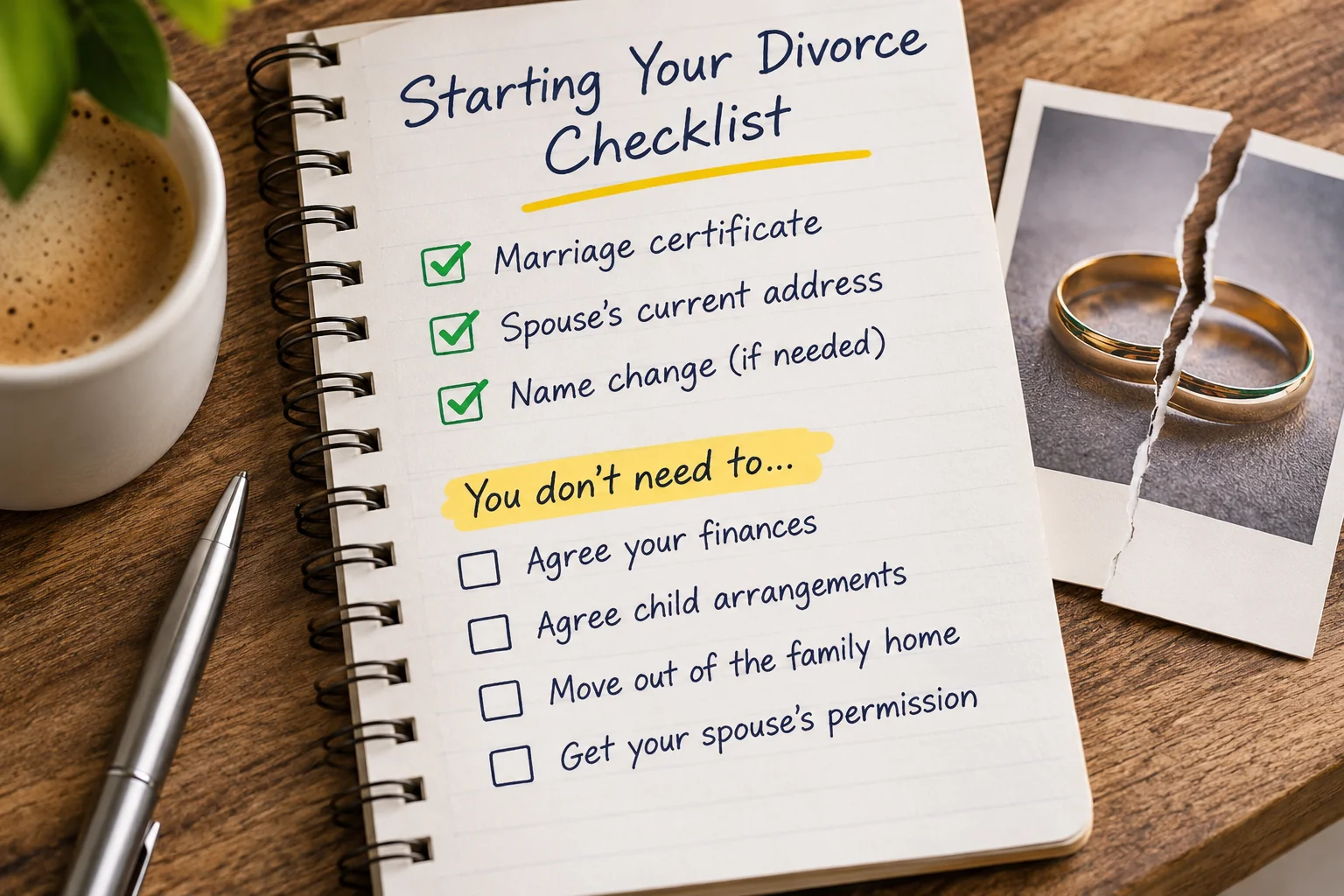
The decision to divorce is undoubtedly one of life’s toughest. And then once you’ve decided to divorce, we often stall again because we think it’s going to be too hard to manage right now, so we keep putting it off.
But you need surprisingly little to start your divorce, and there are a few small details worth getting right to avoid unnecessary delays.
In this guide, I’ll explain exactly what documents and information you need to start a divorce in England and Wales, some common mistakes to avoid and, perhaps most importantly, what you don’t need to have sorted before getting started.
1. Your marriage certificate
The main thing you need is your marriage certificate.
If you’re applying for a divorce online, you’ll need to upload an image of your marriage certificate. In our experience, photographs work better than scans, so we recommend taking a clear photo of the original certificate.
And here’s a small detail that catches people out.
Make sure you can see all four corners of the marriage certificate, with a little of the surface underneath visible around the edges. Don’t crop the photo right up to the sides of the certificate, otherwise the court may reject it.
The image also needs to be clear enough for the court to read all the information.
If you’ve lost your marriage certificate, you can order an official replacement from the General Register Office (GRO) if you married in England or Wales.
2. What if you got married abroad?
If you got married abroad, you can still apply for a divorce in England and Wales, provided you meet the court’s eligibility and jurisdiction requirements.
You’ll need your marriage certificate and, if it’s not in English, a certified English translation.
Make sure the translation is properly certified by the individual who carried it out, rather than just having a company stamp on it. The certification should identify the translator and confirm that the translation is accurate.
You should submit the translation alongside your marriage certificate.
3. Check names and spellings carefully
You’ll be amazed how often the registrar has made a mistake on a marriage certificate.
Before starting your divorce application, check that both names are spelt correctly and match the details you’re entering.
Pay particular attention to middle names, surnames and any differences between the names on your marriage certificate and the names you use now.
If there’s an error, flag it on your application rather than letting the court spot it. Otherwise, you could find your application being delayed while the court asks for an explanation.
What if you’ve changed your name?
If the name you use now is different from the name on your marriage certificate or your married name, you may need evidence of your name change.
For example, if you changed your name by deed poll, you’ll need a copy of that document.
If you’ve lost your deed poll, it may be quicker to arrange a new one rather than trying to track down the original, depending on how your name was changed.
You don’t need a deed poll simply because you took your spouse’s surname when you married. Your marriage certificate can provide evidence of that change.
4. You’ll need your spouse’s current address
Next, you’ll need both of your current addresses.
The court asks for your spouse’s address so it can notify them about the divorce application.
If you’re still living together, that’s straightforward. But what if you’ve been separated for years and have lost touch?
Start by reaching out to friends or family who might know where your spouse is living.
Failing that, it’s possible to use a tracing service to find their address.
Not knowing your spouse’s address doesn’t mean you can’t get divorced. There are alternative court procedures if you’ve made reasonable efforts to find them, although these can add time and potentially additional costs.
If you know your spouse’s email address, it’s also worth having that ready, as the court can use it to send divorce papers electronically.
5. What if you need to keep your address secret?
If you need to keep your address confidential, you can.
For example, you might have left an abusive relationship and don’t want your spouse knowing where you’re living.
If you’re applying for divorce online, you can simply indicate that you want to keep your contact details private.
If you’re submitting a paper application, you’ll also need to complete a separate Form C8, which tells the court to keep your contact details confidential.
Your address will still be provided to the court, but it won’t be shared with your spouse through the divorce paperwork.
6. Do you need to agree your finances before starting a divorce?
No. And this is one of the biggest misconceptions about divorce.
You don’t need to have agreed what happens to the family home, how you’ll divide your savings or whether either of you will receive a share of the other’s pension.
You can start your divorce while you’re still working through these decisions.
In fact, because a divorce takes a minimum of around seven months, it often makes sense to get the divorce underway while you sort out your finances.
However, there’s an important distinction between getting divorced and legally separating your finances.
Your divorce ends your marriage, but it doesn’t automatically end the financial claims you and your spouse may have against each other.
To make your financial agreement legally binding, you’ll need a court-approved consent order.
Ideally, you should have your financial arrangements legally resolved before applying for your Final Order, particularly where pensions are involved.
7. Do you need to agree child arrangements before starting?
No.
You don’t need to have agreed where your children will live, how much time they’ll spend with each parent or what child maintenance will be paid before submitting your divorce application.
These are separate matters that can be worked out while the divorce progresses.
Of course, it’s better for everyone, particularly your children, if you can reach an agreement amicably. But you don’t need to delay your divorce while you work through the details.
8. Do you need to move out of the family home?
No.
You can start and complete your divorce while you’re both still living under the same roof.
This is particularly useful if neither of you can afford to move out until you’ve agreed what happens to the family home.
There’s no requirement to have lived separately for any particular length of time before starting a divorce.
You simply need to have been married for more than a year and meet the legal requirements for divorce in England and Wales.
9. Do you need your spouse’s permission to divorce?
And finally, perhaps most importantly, you do not need your spouse’s permission to get divorced.
Since April 2022, all divorces in England and Wales have been no-fault divorces.
This means you no longer need to prove that your spouse has done something wrong or provide reasons such as unreasonable behaviour or adultery.
You simply confirm that your marriage has broken down irretrievably.
If one party decides the marriage is over, the other can no longer prevent the divorce simply because they don’t agree.
Your spouse will still need to be notified, and there are procedures to follow if they refuse to respond. But they cannot keep you married just because they don’t want the divorce to happen.
10. How much does it cost to start a divorce?
The court fee to apply for a divorce in England and Wales is currently £628.
This is the same whether you make a sole application or apply jointly with your spouse.
If you’re on a low income or receive certain benefits, you may qualify for help with the court fee.
You can make the application yourself through the government’s online divorce service or use a managed service to handle the paperwork and court process for you.
At Easy Online Divorce, our Managed Divorce service costs £299 plus the £628 court fee.
We prepare and submit your application, manage the court process and guide you through each stage until your divorce is finalised.
So, what’s stopping you?
If you’ve been putting off starting your divorce because you’re worried about the paperwork, the finances or whether your spouse will cooperate, hopefully this article has shown you that getting started is more straightforward than you might think.
You don’t need to have all the answers.
You don’t need to have agreed everything.
And you certainly don’t need to wait until every part of your separation has been sorted out.
You just need a few basic details, your marriage certificate and the decision that you’re ready to move forward.
If you’d rather have someone take care of the process for you, our Managed Divorce service can help.
We handle the paperwork, court applications and communication with the court, so you don’t have to worry about getting something wrong.
